
The Zettelkasten method: how to organize a note system
In short
The Zettelkasten method helps systematize knowledge with separate notes and the links between them. We look at the card principle of Niklas Luhmann and the digital adaptation of the method.
The Zettelkasten method is a note-taking system that helps organize knowledge and link ideas together. Instead of storing separate records unrelated to each other, the method suggests building a card index in which every new thought complements existing ones.
How the Zettelkasten method appeared
The word Zettelkasten comes from German and literally means “note box”.
The method is linked with the sociologist Niklas Luhmann, who used a card index to record and organize information throughout his life.
Luhmann created more than 90,000 note cards.
However, the particular feature of his approach lay not so much in the number of records as in the way they were organized.
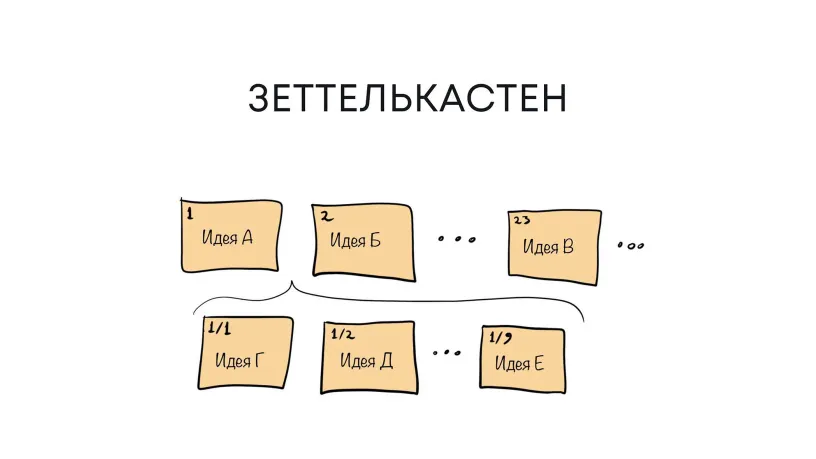
This system is often called the system of “atomic cards” because it involves splitting information into separate ideas and establishing links between them.
When Luhmann found an interesting thought while reading or researching, he wrote it on a separate paper card.
As new ideas appeared, he added cards to the index, linking them with existing records.
A system of letter and number designations was used to organize the links.
For example:
- 1/1 — the card with the initial topic.
- 1/1a — a card linked to the original idea.
- 1/1b — additional thoughts on the topic of card 1/1a.
- 1/1b1 — additional notes linked to the previous records.
Such a system lets you gradually expand the card index, adding new ideas and linking them with existing ones.
Types of cards in the Zettelkasten method
Besides the system of storing and linking records, the method involves dividing notes into several types.
The article covers three categories.
Literature notes
These are the records you make while reading or researching.
When you come across an interesting idea, it is worth writing it down in your own words and noting the source the information came from.
Such notes help keep thoughts from the materials you have read.
Fleeting notes
These are short records that appear at the moment a new idea arises.
It is convenient to keep paper and a pencil at hand for them or to use a note-taking app.
The main task is to save the thought so that you can return to it.
Permanent notes
Permanent notes combine information from literature and fleeting records.
They are included in the main storage system and linked with other cards.
It is important that the content of each note stays clear even after some time.
For this it is recommended to phrase thoughts in your own words and accompany them with links to the relevant materials.
The modern Zettelkasten system
How can a German sociologist’s card index help a writer or researcher who works with digital tools?
Technology lets you use the Zettelkasten method without having to create and store paper cards.
In a digital system, hyperlinks and keywords can be used to link ideas.
If Luhmann used alphanumeric numbering, a digital card index lets you organize links directly between notes.
Each record can have a unique identifier and a link to the source, and internal links help move from one idea to another.
In a certain sense Wikipedia can be compared to a large Zettelkasten system.
Each article is a separate unit of information, and hyperlinks connect the materials with each other.
Notes at the end of pages let you refer to the sources used.
How to use Zettelkasten to organize knowledge
The Zettelkasten method can be adapted for working with digital notes, using apps, links and keywords instead of paper cards.
Such a system helps organize research and ideas that you can return to when preparing texts.
For some users the card index becomes a kind of “second brain” — a place where accumulated knowledge is stored and linked.
Although a paper system may prove cumbersome, the digital format makes it easier to find records and move between linked ideas.
Regular note-taking and the use of backlinks let you build a working knowledge base that can make research and writing easier.
Questions on the topic
What is the Zettelkasten method?
It is a note organization system in which separate cards hold ideas and are linked to each other to form a knowledge base.
Which types of notes are used in Zettelkasten?
The article singles out literature notes, fleeting notes and permanent notes.
Can Zettelkasten be used in a digital format?
Yes. To link notes you can use hyperlinks, keywords and apps instead of paper cards.


